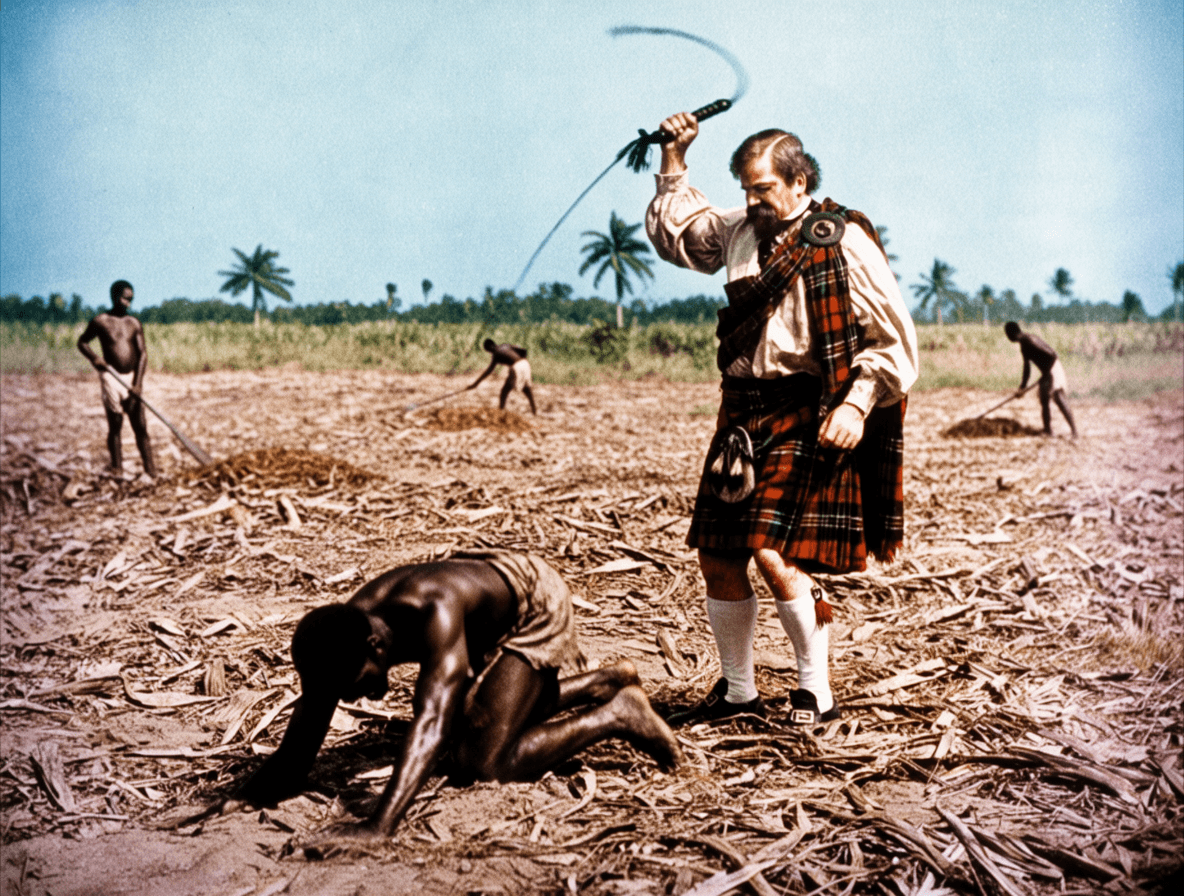
Turn their lives into plantation profit

Let me advise you on the best way to buy a human being.

- Slave Owner - William MacKinnon - Current MacKinnon Clan Chiefly Line

Historical Note

These materials document correspondence between enslavers, plantation managers, and slave traders, including William Mackinen or Mackinnon, Stephen Blizard, Abraham Redwood, and their commercial associates in Antigua. They are not neutral administrative records. They expose a system in which Black people were discussed as purchasable units of labour, reproductive assets, financial instruments, and plantation “stock”.

In William Mackinen’s letter to Abraham Redwood from Antigua in seventeen fifty-three, he advised Redwood on “buying negros”, recommended selecting people from the “best countrys”, and described some men as “not worth the expence”. He urged Redwood to buy women and girls alongside men and boys so that the estate would be “stock’t with creoles” for Redwood’s children. The logic is brutally clear: enslaved women and girls were being evaluated not only as workers, but as a means of reproducing the plantation labour force across generations. Mackinen also measured the estate’s value through forced production, arguing that it would make far more sugar if it were “equally slaved”.

Later letters make the same violence visible in even colder commercial terms. In seventeen fifty-five, Mackinen and Stephen Blizard reported the purchase of twenty-three enslaved people from the Gold Coast, listing eighteen men and five women with prices in pounds sterling, then explaining that Redwood would get months of labour from them before having to pay interest on the purchase money. In another letter that same year, they described a “very fine cargo” of enslaved people, said they had taken ten without waiting for Redwood’s reply, and justified the purchase by the expected crop, labour shortage, scarcity, and future price increases. Human beings appear here as cargo, credit, labour capacity, risk, scarcity, and sugar output.

This language is not incidental. It shows the plantation system operating exactly as a machine of racial capitalism: people were bought, sorted by origin, sex, age, and perceived usefulness, priced against expected returns, and folded into inheritance plans. The violence is not only in physical punishment or coercion, but also in the administrative language itself. The letters reduce enslaved Africans and Creoles to stock, expense, cargo, plantation capacity, and future profit. That is dehumanization in its working form.

This also matters for the public presentation of Clan MacKinnon history. The Clan MacKinnon Society states that it is aware of a report that “a MacKinnon forebear was engaged in the slave trade” and denounces that activity. But the evidence is broader than a vague or distant association. Bath Abbey Memorials identifies William Mackinnon, also known as William Mackinnon of Strathaird and the thirty-first Chief of Mackinnon, as a plantation owner linked to Antigua and the transatlantic slave trade. It also notes that correspondence with Redwood shows Mackinnon treating enslaved people as a “commodity” and encouraging the purchase of women to increase the estate’s “stock” of forced labour.

Nor was this connection isolated from the chiefly line. People Australia states that William Alexander Mackinnon, who became the thirty-third Chief of Clan Mackinnon after his grandfather’s death in eighteen hundred nine, came from a family in which his father, grandfather, great-grandfather, and great-great-grandfather had all owned estates and enslaved people in Antigua. It also records that in eighteen thirty-four he and his aunt received compensation connected to two hundred seventy-nine enslaved people on the Mackinnon Estate in Antigua.

So the issue is not merely that one remote ancestor had some connection to slavery. The Antigua plantation economy, the ownership of enslaved people, and the profits and compensation derived from that system were embedded in the same family line that carried the MacKinnon chiefship forward. The surviving letters show how that power was maintained in practice: through purchase, forced labour, reproductive control, racial ranking, and inheritance. Any public account that frames this only as a distant or isolated blemish risks obscuring the fact that slavery was structurally tied to the wealth, status, and continuity of the Antigua MacKinnons and their chiefly line.
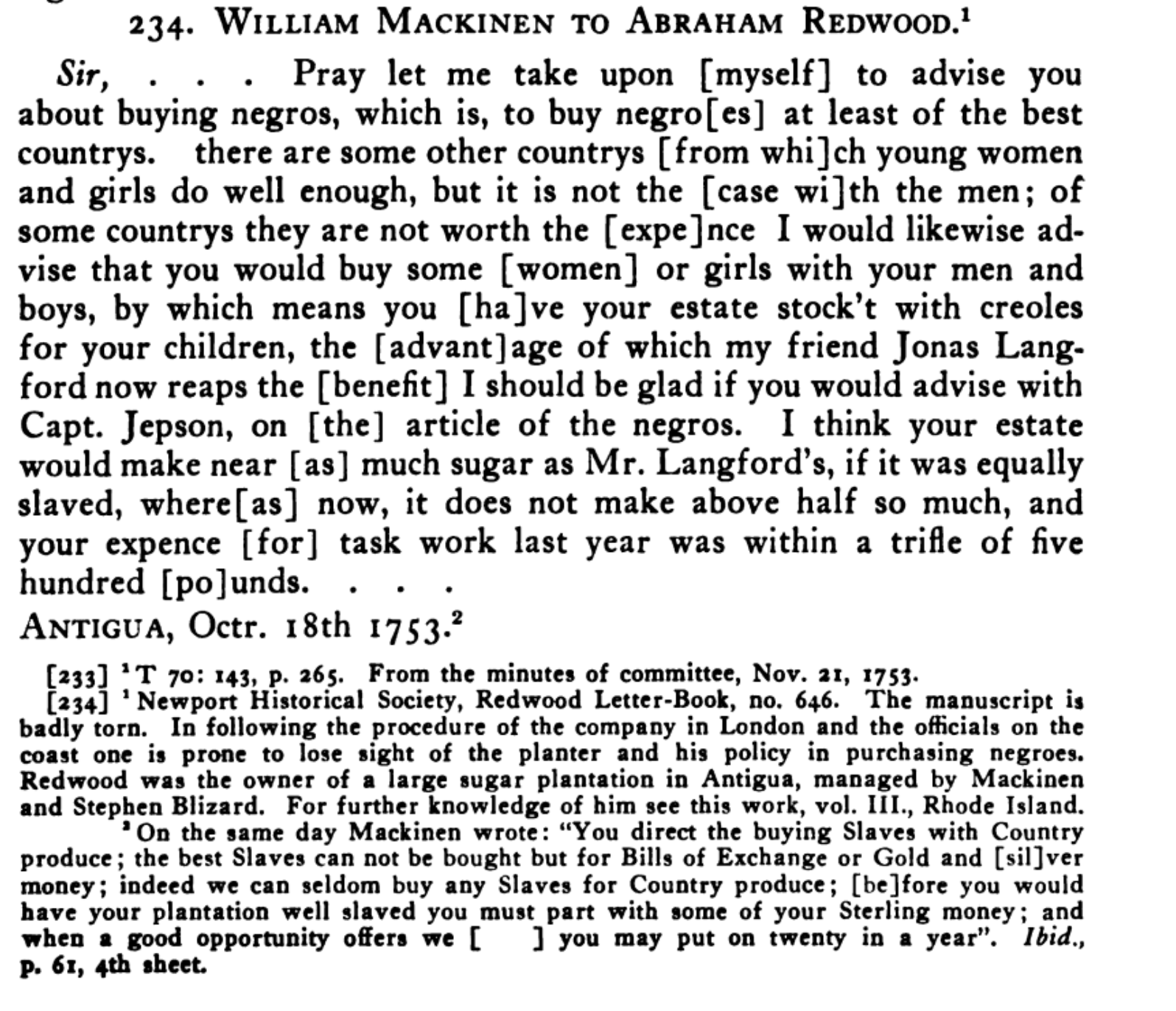
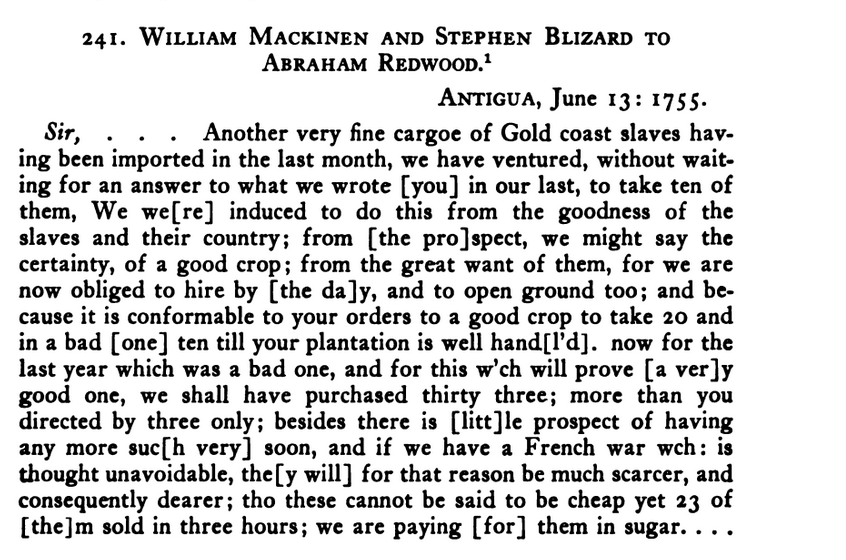
Letters Concerning the Plantation at Antigua: Abraham Redwood and William MacKinen (MacKinnon)

emmajanemackinnonlee-william-mackinnon-antigua-slavery-letter-redwood-october-1753

Transcription

234. WILLIAM MACKINEN TO ABRAHAM REDWOOD.¹ Sir, . . . Pray let me take upon [myself] to advise you about buying negros, which is, to buy negro[es] at least of the best countrys. there are some other countrys [from whi]ch young women and girls do well enough, but it is not the [case wi]th the men; of some countrys they are not worth the [expe]nce I would likewise ad- vise that you would buy some [women] or girls with your men and boys, by which means you [ha]ve your estate stock’t with creoles for your children, the [advant]age of which my friend Jonas Lang- ford now reaps the [benefit] I should be glad if you would advise with Capt. Jepson, on [the] article of the negros. I think your estate would make near [as] much sugar as Mr. Langford’s, if it was equally slaved, where[as] now, it does not make above half so much, and your expence [for] task work last year was within a trifle of five hundred [po]unds. . . . ANTIGUA, Octr. 18th 1753.² [233] ¹ T 70: 143, p. 265. From the minutes of committee, Nov. 21, 1753. [234] ¹ Newport Historical Society, Redwood Letter-Book, no. 646. The manuscript is badly torn. In following the procedure of the company in London and the officials on the coast one is prone to lose sight of the planter and his policy in purchasing negroes. Redwood was the owner of a large sugar plantation in Antigua, managed by Mackinen and Stephen Blizard. For further knowledge of him see this work, vol. III., Rhode Island. ² On the same day Mackinen wrote: “You direct the buying Slaves with Country produce; the best Slaves can not be bought but for Bills of Exchange or Gold and [sil]ver money; indeed we can seldom buy any Slaves for Country produce; [be]fore you would have your plantation well slaved you must part with some of your Sterling money; and when a good opportunity offers we [ ] you may put on twenty in a year”. Ibid., p. 61, 4th sheet.

emmajanemackinnonlee-william-mackinnon-antigua-slavery-letter-redwood-june-1755

Transcription

241. WILLIAM MACKINEN AND STEPHEN BLIZARD TO ABRAHAM REDWOOD.¹ ANTIGUA, June 13: 1755. Sir, . . . Another very fine cargoe of Gold coast slaves hav- ing been imported in the last month, we have ventured, without wait- ing for an answer to what we wrote [you] in our last, to take ten of them, We we[re] induced to do this from the goodness of the slaves and their country; from [the pro]spect, we might say the certainty, of a good crop; from the great want of them, for we are now obliged to hire by [the da]y, and to open ground too; and be- cause it is conformable to your orders to a good crop to take 20 and in a bad [one] ten till your plantation is well hand[l’d]. now for the last year which was a bad one, and for this w’ch will prove [a ver]y good one, we shall have purchased thirty three; more than you directed by three only; besides there is [litt]le prospect of having any more suc[h very] soon, and if we have a French war wch: is thought unavoidable, the[y will] for that reason be much scarcer, and consequently dearer; tho these cannot be said to be cheap yet 23 of [the]m sold in three hours; we are paying [for] them in sugar. . . .

emmajanemackinnonlee-william-mackinnon-antigua-slavery-letter-redwood-march-1757

Transcription

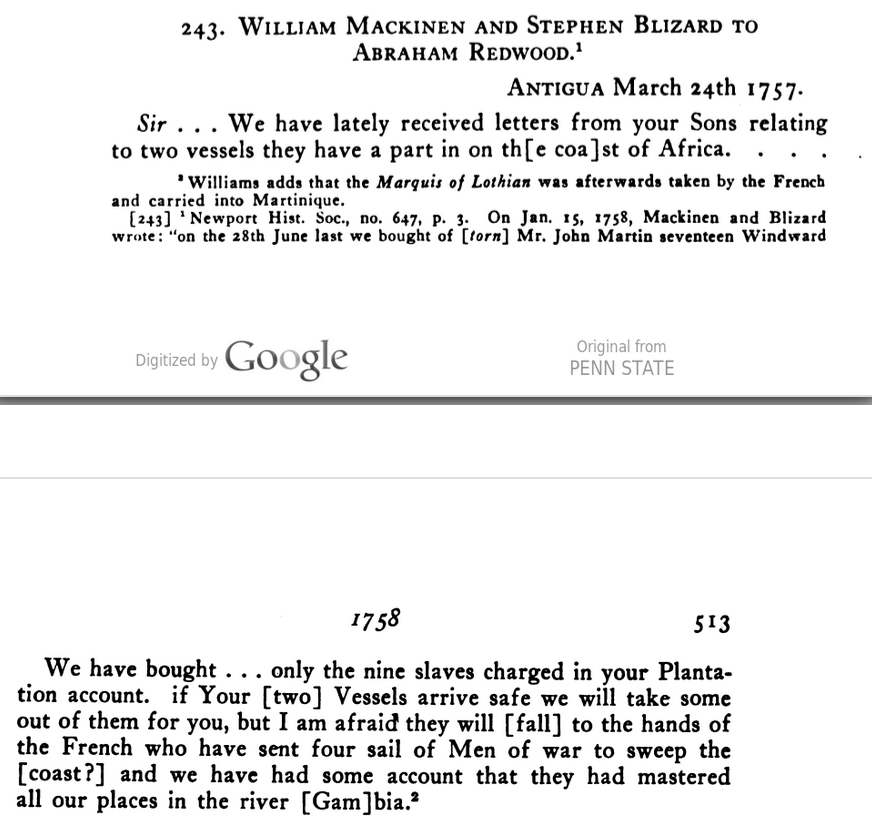
243. WILLIAM MACKINEN AND STEPHEN BLIZARD TO ABRAHAM REDWOOD.¹ ANTIGUA March 24th 1757. Sir. . . . We have lately received letters from your Sons relating to two vessels they have a part in on th[e coa]st of Africa. . . . ¹ Williams adds that the Marquis of Lothian was afterwards taken by the French and carried into Martinique. [243] ¹ Newport Hist. Soc., no. 647, p. 3. On Jan. 15, 1758, Mackinen and Blizard wrote: “on the 28th June last we bought of [torn] Mr. John Martin seventeen Windward. 1758 513 We have bought . . . only the nine slaves charged in your Planta- tion account. if Your [two] Vessels arrive safe we will take some out of them for you, but I am afraid they will [fall] to the hands of the French who have sent four sail of Men of war to sweep the [coast?] and we have had some account that they had mastered all our places in the river [Gam]bia.²

emmajanemackinnonlee-william-mackinnon-antigua-slavery-letter-redwood-february-1755

Transcription

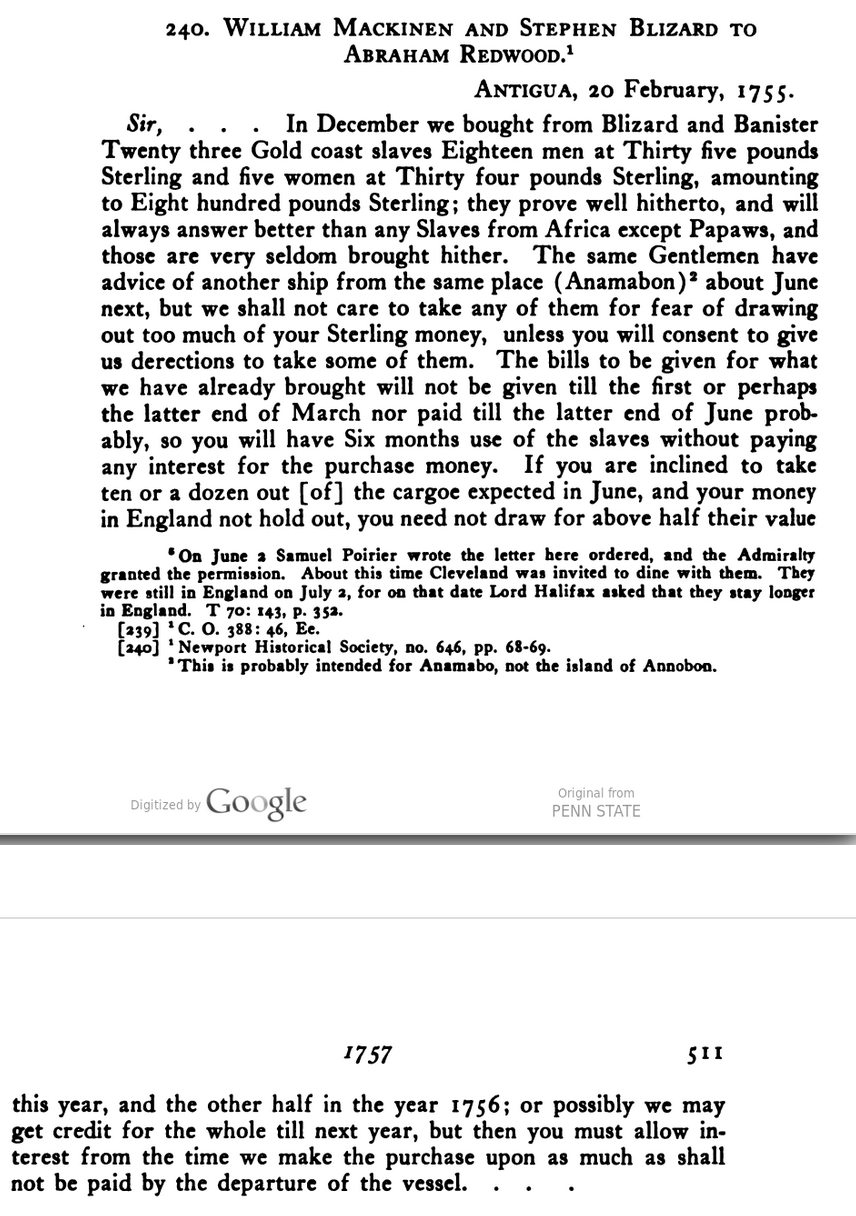
240. WILLIAM MACKINEN AND STEPHEN BLIZARD TO ABRAHAM REDWOOD.¹ ANTIGUA, 20 February, 1755. Sir, . . . In December we bought from Blizard and Banister Twenty three Gold coast slaves Eighteen men at Thirty five pounds Sterling and five women at Thirty four pounds Sterling, amounting to Eight hundred pounds Sterling; they prove well hitherto, and will always answer better than any Slaves from Africa except Papaws, and those are very seldom brought hither. The same Gentlemen have advice of another ship from the same place (Anamabon)² about June next, but we shall not care to take any of them for fear of drawing out too much of your Sterling money, unless you will consent to give us directions to take some of them. The bills to be given for what we have already brought will not be given till the first or perhaps the latter end of March nor paid till the latter end of June prob- ably, so you will have Six months use of the slaves without paying any interest for the purchase money. If you are inclined to take ten or a dozen out [of] the cargoe expected in June, and your money in England not hold out, you need not draw for above half their value [239] C. O. 388:46, Ee. [240] ¹ Newport Historical Society, no. 646, pp. 68-69. ² This is probably intended for Anamabo, not the island of Annobon. 1757 511 this year, and the other half in the year 1756; or possibly we may get credit for the whole till next year, but then you must allow in- terest from the time we make the purchase upon as much as shall not be paid by the departure of the vessel. . . .

What can the sanitized language of the archive obscure?

emmajanemackinnonlee-artists-vision-mackinnon-antigua-plantation-overview
emmajanemackinnonlee-artists-vision-mackinnon-antigua-plantation-cane-field
emmajanemackinnonlee-artists-vision-mackinnon-antigua-plantation-boiling-house

PDF Downloads